




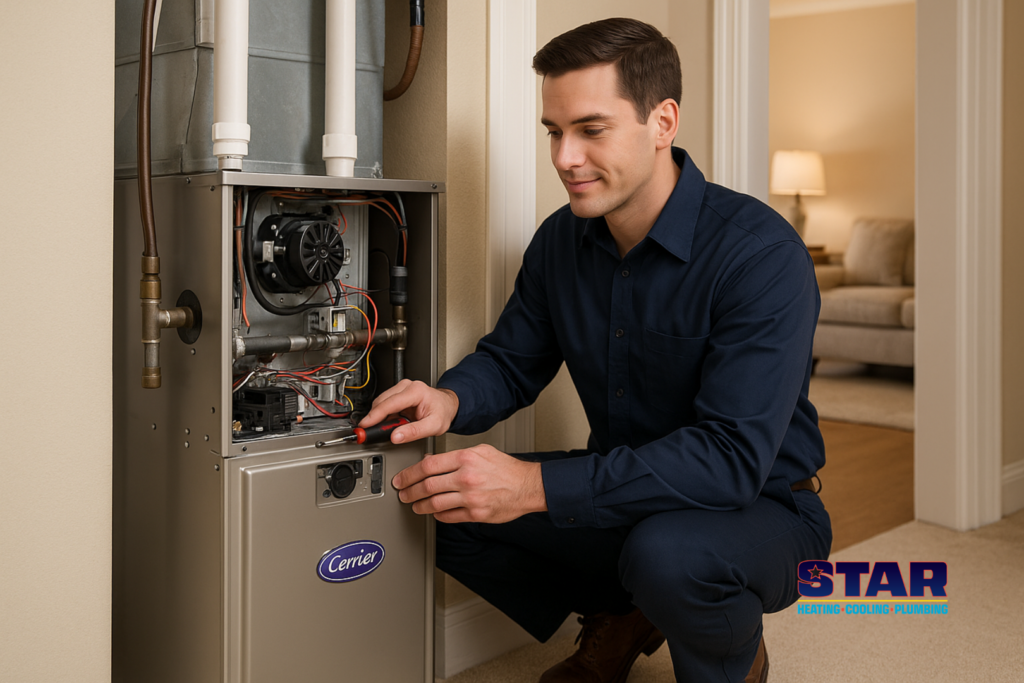
What Carmel, IN Homeowners Need to Know About Gas Furnaces
Gas furnaces Carmel IN homeowners rely on are a critical part of surviving Indiana winters — and choosing, maintaining, or replacing the right one can make a real difference in your comfort and energy use.
Here’s a quick overview of what you need to know:
- Indiana requires 90%+ AFUE for all new gas furnace installations (Northern region DOE standard)
- Modern high-efficiency furnaces can significantly reduce fuel waste compared to older units
- Carmel winters are no joke — average lows hit 18°F with 23 inches of snowfall per year
- Furnace types matter — single-stage, two-stage, and modulating furnaces offer different levels of comfort and efficiency
- Regular maintenance helps prevent breakdowns and keeps your system running safely all season long
When winter temperatures drop in Carmel, your furnace isn’t just a convenience — it’s a necessity. Older systems with AFUE ratings of 65% or lower waste a large portion of the fuel you pay for. Upgrading to a modern, high-efficiency unit doesn’t just keep your home warmer — it helps your system run cleaner and more reliably through the coldest nights of the year.
I’m Jeff Rich II, a leader at Star Heating, Cooling & Plumbing with a lifelong background in the trades, and I’ve seen how the right gas furnace choice transforms comfort for homeowners dealing with gas furnaces in Carmel, IN. In the sections below, I’ll walk you through everything from efficiency ratings and furnace types to maintenance best practices and replacement signs, so you can make the most informed decision for your home.

Gas furnaces carmel in vocab explained:
Understanding Gas Furnaces in Carmel, IN
When we talk about gas furnaces in Carmel, IN, we are discussing the backbone of home comfort. In our region, natural gas is the most popular fuel source for heating because it is incredibly effective at combatting the deep freezes we experience. Unlike electric furnaces, which can struggle to keep up when the mercury drops to 18°F, gas systems provide a steady, intense heat that warms a home quickly.
To understand your furnace, you first need to understand AFUE, or Annual Fuel Utilization Efficiency. Think of this like your car’s MPG, but for heat. If a furnace has an 80% AFUE rating, 80 cents of every dollar you spend on gas goes toward heating your home, while 20 cents escapes through the chimney. Many older Carmel homes still have units from the 1990s with ratings as low as 65%. Upgrading to a modern unit can drastically change your monthly budget.
Before diving into the technical specs, it helps to know the basics of the “how” and “why.” You can learn more about the inner workings in our guide on how a gas furnace works or settle the debate of gas vs. electric furnaces to see which fits your lifestyle best.
Why High-Efficiency Gas Furnaces Carmel IN Matter
In Indiana, efficiency isn’t just a suggestion; it’s a regional standard. The United States is divided into heating regions, and because Indiana falls into the Northern region, the Department of Energy requires new installations to meet a minimum of 90% AFUE.
Why the high bar? Because our winters demand it. A high-efficiency furnace (90% to 98.3% AFUE) uses a second heat exchanger to extract heat from exhaust gases that standard furnaces simply vent away. This process saves significant energy and reduces your carbon footprint. For a deeper look at how these units pay for themselves over time, check out our guide to affordable gas furnaces in Carmel.
Comparing Furnace Stages and Performance
When selecting gas furnaces in Carmel, IN, the “stage” of the furnace refers to how the gas valve and blower operate. It’s the difference between a light switch (on/off) and a dimmer switch (adjustable).
| Furnace Type | Operation Style | Comfort Level | Efficiency |
|---|---|---|---|
| Single-Stage | Runs at 100% capacity or is off. | Basic; can have temperature swings. | Standard (80%-90%) |
| Two-Stage | Has a “low” setting for mild days and “high” for cold snaps. | High; quieter and more consistent. | High (90%-96%) |
| Modulating | Adjusts in tiny increments to match heat loss exactly. | Superior; the gold standard of comfort. | Ultra-High (up to 98%+) |
Every furnace contains four main components:
- Gas Control Valve: Regulates fuel flow.
- Burners: Where the gas ignes to create heat.
- Heat Exchanger: The metal chamber that transfers heat to your home’s air.
- Blower Motor: The fan that pushes warmed air through your ducts.
Key Features of Modern Heating Technology
Modern gas furnaces in Carmel, IN are lightyears ahead of the “clunky” units of the past. One of the most significant advancements is the Variable-Speed ECM (Electronically Commutated Motor). Unlike older motors that were either full-blast or silent, these motors can slowly ramp up and down. This eliminates that sudden “whoosh” of cold air when the cycle starts and keeps the air moving at a whisper-quiet level.
If you are looking for the best in class, you can explore our furnace category for latest updates or read our premium heating service guide to see how high-end features integrate into your home.
Benefits of Variable-Speed Gas Furnaces Carmel IN
Variable-speed technology offers more than just peace and quiet. Because the fan can run at lower speeds for longer periods, it provides:
- Better Air Filtration: Air passes through your filters more frequently, catching more dust and allergens.
- Humidity Control: In the summer (when paired with an AC), it helps pull more moisture out of the air.
- Electrical Savings: These motors use significantly less electricity than standard blowers.
Sometimes, homeowners wonder if they should stick with a furnace or try something else. We often help clients decide if a heat pump or a gas furnace is right for their specific Carmel property.
Advanced Comfort Systems
We also see a lot of interest in modulating heat. A modulating furnace can adjust its heat output to within 1% of what is needed. When paired with a smart thermostat, your home stays within half a degree of your target temperature. This level of precision is perfect for the large, multi-story homes found throughout Carmel, ensuring that the upstairs bedrooms stay just as warm as the living room. For those also thinking about the warmer months, our Carmel air conditioning services ensure your entire HVAC system works in harmony.
When to Consider a Furnace Replacement
Knowing when to say goodbye to your old furnace is tricky. Most gas furnaces have a lifespan of 15 to 20 years. If your unit is approaching its second decade, it’s time to start planning. You don’t want to be forced into a decision during the coldest stretch of winter when your system finally gives up.
If you are noticing your system struggling or you’re scheduling frequent repairs, it might be time to look at heater repair services to see if a fix is viable, or read up on the signs your furnace is failing.
Signs Your System is Failing
Keep an eye (and ear) out for these red flags:
- Uneven Heating: Some rooms are freezing while others are sweltering.
- Strange Noises: Banging, whistling, or rattling often points to mechanical failure.
- Yellow Burner Flame: A healthy gas flame should be blue. A yellow flame can indicate incomplete combustion and the presence of carbon monoxide.
- Rising Bills: If your gas usage hasn’t changed but your bill has, the unit may be losing efficiency.
For more detailed troubleshooting, our furnace repair guide can help you identify if a professional visit is necessary.
Choosing the Right Size for Your Home
One of the biggest mistakes a homeowner can make is buying a furnace that is too large for their home. A “bigger is better” mentality leads to “short-cycling,” where the furnace turns on and off rapidly, wearing out components and wasting fuel.
We perform detailed load calculations that factor in your square footage, insulation quality, window types, and even home orientation. This ensures your new system is perfectly sized for your specific needs. Learn more about our approach to Carmel heating services to see how we customize every installation.
The Importance of Professional Maintenance
If there is one thing we stress to every Carmel resident, it is that maintenance is not optional. A gas furnace is a combustion appliance; it burns fuel to create heat. Regular checks help ensure that this process remains safe and that no cracked heat exchangers are leaking carbon monoxide into your home.
Beyond safety, maintenance is about performance and longevity. A clean furnace runs more efficiently and tends to last longer. We provide a comprehensive gas furnace maintenance guide and specific maintenance tips to help you keep your system in top shape between professional visits.
Protecting Your Investment with Regular Care
During a professional tune-up, we do more than just “look” at the unit. We:
- Clean the Burners: Helping promote efficient combustion.
- Inspect Electrical Connections: Helping prevent safety hazards and system failures.
- Lubricate Moving Parts: Reducing friction and wear on the motor.
- Check the Heat Exchanger: Looking for microscopic cracks.
Learn about professional furnace care that goes beyond the basics.
Seasonal Tune-Up Benefits
Scheduling a tune-up in the fall, before the first frost, offers several benefits:
- Warranty Compliance: Most manufacturers require annual maintenance to keep your warranty valid.
- Safety: We test for carbon monoxide and gas leaks.
- Efficiency: We optimize the airflow to help ensure you get consistent, reliable heat.
For those who want to ensure they are fully prepared for the season, our furnace maintenance guide covers everything you need to know about keeping the heat on.
Frequently Asked Questions about Gas Furnaces
What is the difference between 80% and 95% AFUE?
The percentage represents how much fuel is converted to usable heat. An 80% AFUE furnace loses 20% of its energy through exhaust. A 95% AFUE furnace only loses 5%. Over a decade in Carmel’s climate, the 95% model can save thousands of dollars in gas costs.
How long do gas furnaces typically last in Indiana?
In our region, you can expect a well-maintained gas furnace to last 15 to 20 years. However, without regular maintenance, that lifespan can drop to 10-12 years due to the heavy workload required during Indiana winters.
Can a new furnace improve my home’s indoor air quality?
Yes! Modern furnaces with variable-speed motors allow for constant air circulation. When combined with high-quality filters or whole-home air purifiers, they can significantly reduce dust, pet dander, and allergens in your home.
Conclusion
At Star Heating, Cooling & Plumbing, we are proud to be a family-owned business serving Carmel and the surrounding areas. As a Carrier Factory Authorized Dealer, we focus on more than just “selling” a furnace; we focus on educating our neighbors so they can make the best choice for their families. Whether you need a simple tune-up, a complex repair, or a brand-new high-efficiency installation, our team is committed to transparency and your total satisfaction.
Don’t wait until the next “polar vortex” to think about your heating system. Explore our Carmel heating services today and let us help you stay warm, safe, and efficient all winter long.